To fill my bibliology section, I thought it useful to examine the methodology and history of the King James Version, given the variants in the Textus Receptus and the interesting 1611 English words tend to spark debates. I imagine this study can span ten or more articles.
I’ve probably spent too long arguing with the KJV-Only community, partly being why I feel it would be useful to create several long-form articles to collect my thoughts for future reference. Honestly, I don’t want to “win” them away from God’s Word. I do hope we can all appreciate a balanced approach in objectively reviewing a handful of words.
Let me also be upfront about something. These KJV odd “problem” words make up about one to two percent of the total text, depending on how you classify them. The bulk of the translation is a beautiful and edifying work that I don’t wish to discourage anyone from reading. Yet even one clear example of an anachronism or other error shows it is not perfect. Any translation is a fallible human attempt to convey the inspired truth of the original text, carefully compiled from various sets of remaining manuscripts across multiple languages.
For this first set of KJV words, the translation choices for some animals are an easy target to highlight. Unicorn, I thought, would be a fun start.
Today we think of unicorns as mythical creatures in fantasy games and children’s shows. Ctesias, writing around 400 BC, makes the earliest known reference to them as an exotic beast of India.1 The ancient world consistently viewed them as natural creatures. Then, sometime between the second and fourth centuries AD, the Physiologus popularized a Christian allegorization of the unicorn as a figure of the Incarnation.2 Medieval charlatans would later sell “unicorn horns,” likely narwhal tusk, as various cure-all remedies.3
The KJV translates re’em (רְאֵם) as unicorn nine times: Numbers 23:22; 24:8; Deuteronomy 33:17; Job 39:9–10; Psalm 22:21; 29:6; 92:10; and Isaiah 34:7. Although the translators surely knew the history of exotic creatures believed to be real by the Greeks, they followed a linguistic tradition running back to Jerome. They borrowed from his Latin unicornis, which was itself translated from the Septuagint’s use of monoceros (μονόκερως).
Jerome was influenced directly by Pliny the Elder (AD 23/24–79). In his Natural History, Pliny describes the monoceros like a terrifying chimera with the head of a stag, the body of a horse, the feet of an elephant, and the tail of a boar. He specifically noted it having “a single black horn… which projects from the middle of its forehead.”4
However, Pliny was not inventing a mythical creature. Like the Greek historians before him, he was retelling second-hand stories from Indian merchants. It may have been like the classic game of telephone, where several different animals were combined into one composite. More likely, though, Pliny could have been using features of known animals as analogous illustrations for a creature unknown to his readers. Most historians today believe the unicorn and later monoceros accounts describe the Indian rhinoceros.5
The Septuagint, or LXX, uses the same Greek word. Monoceros is made up of monos for “one” and keras for “horn.” Naturally, when Jerome looked at the word for his Latin volume, the best equivalent for what seemed to be a single-horned animal would have been unicornis.
However, he noticed a textual problem in Deuteronomy 33:17 and other places that implied an animal with multiple horns. For those references he used rhinocerotis, from which we get the word rhinoceros, literally meaning “nose-horn.” Of the nine KJV unicorn verses, the Vulgate translates rhinocerotis six times (Numbers 23:22; 24:8; Deuteronomy 33:17; Job 39:9, 10; Psalm 29:6), unicornis twice (Psalm 22:21; 92:10), and uses a Latin transliteration once in Isaiah 34:7.6
Although the same Greek and Hebrew word stands in the ancient manuscripts, Jerome chose to contextualize the meaning to fit the text. Centuries later, in 1611, the KJV translators standardized the text by using the English word unicorn each time. They appear to have prioritized a consistent English rendering over Jerome’s contextual word choice.
Ironically, Jerome held to a “Hebrew truth” principle (hebraica veritas) and wanted to get away from reliance on the LXX. He even moved to Bethlehem to be tutored by rabbis and Jewish converts.7 However, by the fourth century AD, the best scholars were deeply divided over the meaning of re’em. The Talmud describes it as a colossal beast too large to fit on Noah’s ark, so large that only two breeding kinds of these legendary animals could exist on the earth at once.8 Other scholars, like Aquila of Sinope, rendered it with a term for a species of desert antelope.9
Jerome was conflicted between two competing theories: the colossal myth or a literal animal? Re’em was a dead word by his time. He simply defaulted back to the LXX with flexible adjustments.
It is often pointed out online that rhinos have a single horn, and thus that Deuteronomy 33:17 mentioning multiple horns of a singular animal should clearly rule rhinos out of the running. Yet that reasoning oversimplifies the issue. Indian rhinoceroses indeed do have a single horn, even bearing the scientific name Rhinoceros unicornis, but the black rhinoceros has two horns and would certainly have been known to Jerome.10 The Asian and African species are often used interchangeably as unicorns in ancient texts.
The KJV translators inherited the cultural understanding of Jerome, even as they moved toward linguistic consistency. They added a marginal note at Isaiah 34:7 in their original 1611 publication: “or, Rhinocerots.”11
Yet archaeology shows rhinoceroses in Egypt and the greater Palestine region had long been extinct by the time of the Exodus, thousands of years prior.12 We might question how an animal unfamiliar to the Israelites would carry any significance as a metaphor.
What the Assyrians Knew
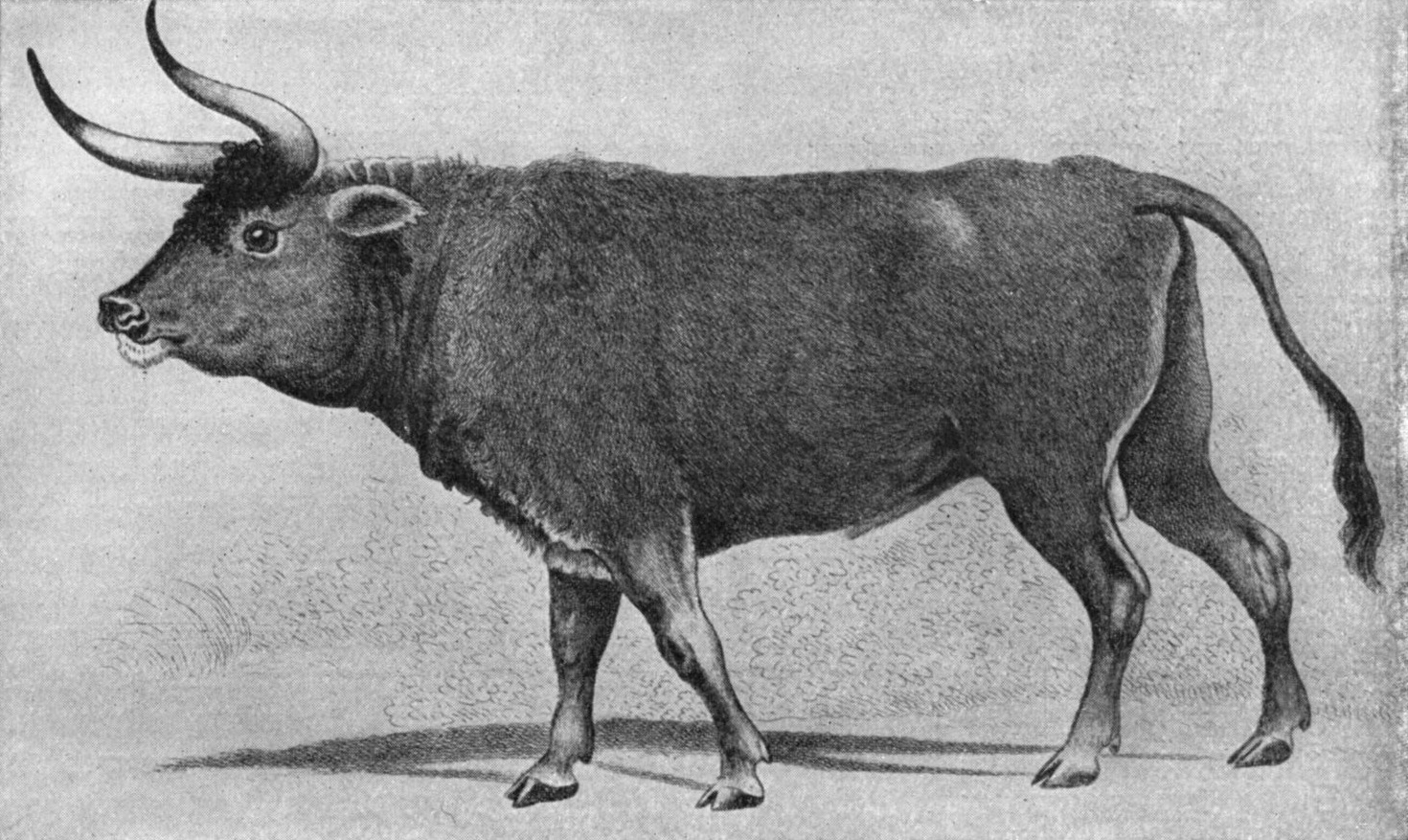
By the nineteenth century, historians had deciphered Akkadian cuneiform tablets from Old Assyrian ruins. Since Hebrew is a related Semitic language, they were able to identify the cognate form of re’em in Akkadian rīmu. Unlike the Bible, which uses re’em mostly symbolically, the Assyrian hunting records always used the term literally, of a local animal we now know as the extinct aurochs.13
The aurochs likely died out in the Levant during the Iron Age (1200–586 BC). Thus, while the Israelites of Moses’ day would have known of them, the memory of the animal could well have been lost to the LXX translators. If they mistakenly guessed the animal was a rhinoceros, whether the two-horned or single-horned species, Jerome cannot be faulted for simply inheriting the tradition.
Most modern versions translate re’em as “wild ox,” which is accurate zoologically but is an understatement considering the massive size of the aurochs.14 It stood nearly six feet at the shoulder, bore long curved horns, and was one of the most fearsome beasts of the ancient world. When Scripture speaks of the “horns of the re’em” (Numbers 23:22; Deuteronomy 33:17), it is meant to invoke untamable power, not modern livestock.
Should We Call It an Error?
Should we treat the nine unicorn translations in the KJV as “errors”? The 1611 translators were working with the best sources they had at the time, with no conceivable way to know of the aurochs. This is exactly how the KJV should be viewed: a work of its time, reflecting the historical limitations of its period.
- Ctesias of Cnidus, Indica, surviving only in epitome; see Photius, Bibliotheca, cod. 72. Translation and commentary in Andrew Nichols, Ctesias: On India (London: Bristol Classical Press, 2011), 55–57. ↩
- Physiologus, ch. 22 (“The Unicorn”). Dating is disputed; Michael J. Curley places the original Greek text in Alexandria between the second and fourth centuries AD. Michael J. Curley, trans., Physiologus: A Medieval Book of Nature Lore (Chicago: University of Chicago Press, 2009), xvi–xxi. ↩
- Odell Shepard, The Lore of the Unicorn (London: Allen & Unwin, 1930), 101–28. ↩
- Pliny the Elder, Natural History 8.31.76, trans. John Bostock and H. T. Riley (London: Taylor and Francis, 1855). ↩
- See Shepard, Lore of the Unicorn, 26–40; and Chris Lavers, The Natural History of Unicorns (New York: William Morrow, 2009), 1–30. ↩
- Counts taken from the Clementine Vulgate. Readings vary across Vulgate manuscript families and printed editions, so a given verse may appear as rhinoceros in one edition and unicornis in another. ↩
- Jerome, “Preface to the Books of Samuel and Kings” (the Prologus Galeatus); see also J. N. D. Kelly, Jerome: His Life, Writings, and Controversies (London: Duckworth, 1975), 153–67. ↩
- b. Zevachim 113b; cf. b. Bava Batra 73b for the re’em as a beast of legendary size. ↩
- Aquila’s renderings survive only in Hexaplaric fragments and patristic citation; see Frederick Field, Origenis Hexaplorum quae supersunt (Oxford: Clarendon, 1875), and the discussion of re’em in the apparatus at Deuteronomy 33:17 and Psalm 92:10. ↩
- Indian rhinoceros, Rhinoceros unicornis; black rhinoceros, Diceros bicornis, which bears two horns and ranged across North Africa in antiquity. ↩
- Marginal note at Isaiah 34:7 in the 1611 edition. See The Holy Bible: 1611 Edition, facsimile (Nashville: Thomas Nelson, 1982). ↩
- On the disappearance of the rhinoceros from the Nile Valley and Levant well before the second millennium BC, see Dale J. Osborn and Jana Osbornová, The Mammals of Ancient Egypt (Warminster: Aris & Phillips, 1998), 137–39. ↩
- Akkadian rīmu, “wild bull, aurochs”; see The Assyrian Dictionary of the Oriental Institute of the University of Chicago (CAD), vol. 14, R, 359–61. Royal hunting inscriptions using the term include the annals of Tiglath-pileser I. ↩
- HALOT, s.v. רְאֵם, “wild bull, Bos primigenius”; cf. BDB, 910. On size and extinction, see Cis van Vuure, Retracing the Aurochs: History, Morphology and Ecology of an Extinct Wild Ox (Sofia: Pensoft, 2005), 55–70. ↩